



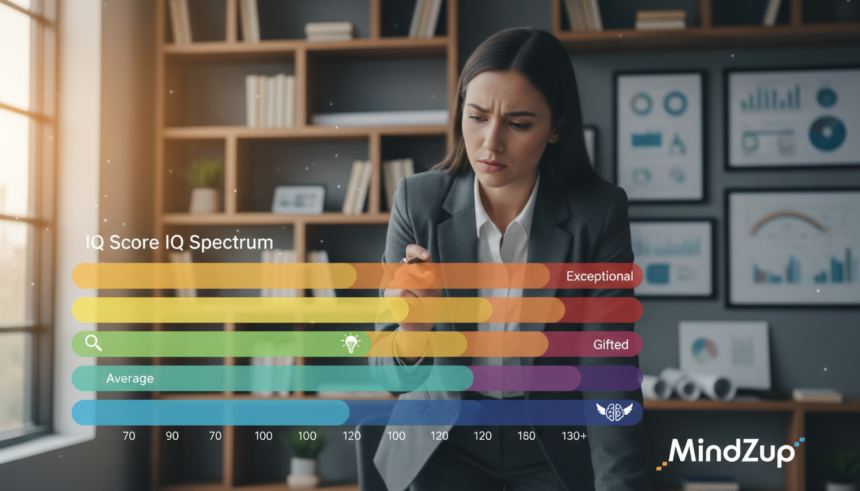
Have you ever taken a test that left you questioning your abilities? You are not alone. Many people grapple with understanding what their results truly signify. The concept of intelligence, as defined by William Stern in 1912, has evolved over the years. Today, it encompasses more than just a number on a page.
When you receive your results, it can feel overwhelming. You might wonder how your performance stacks up against others. This is where the iq score chart comes into play. It offers a standardized way to evaluate your cognitive abilities. More importantly, it provides insight into your unique strengths and areas for growth.
In this guide, we will explore how your results reflect your mental performance. Understanding this can help you view your scores with a balanced perspective. After all, every individual has their own journey of learning and development.
Understanding the Basics of IQ and Its Measurement
You might be surprised at how much your intelligence assessment reveals about you. Understanding what IQ represents is essential for interpreting your results. The average IQ score is set at 100, which serves as a benchmark for evaluating intelligence across populations.
Standardized tests, such as the Wechsler Adult Intelligence Scale, are designed to provide a structured framework for assessing mental abilities. These tests measure various cognitive abilities, which are crucial for daily tasks.
- The average score of 100 allows for consistent comparisons between individuals of the same age.
- Modern tests assess reasoning, problem-solving, and comprehension skills.
- Results give a snapshot of a person’s intellectual potential relative to their age group.
- Psychometricians norm tests to ensure the average intelligence equals exactly 100 points.
- These assessments help categorize performance within a scientifically validated framework.
The History and Evolution of IQ Testing
The journey of understanding intelligence has a rich history that shapes modern assessments. In 1912, William Stern introduced the term intelligence quotient. This concept was groundbreaking as it quantified mental development by comparing mental age to chronological age.
Initially, testing was conducted individually by trained psychologists. However, the first group test was developed for the US Army. This innovation allowed for mass assessment and later spread to schools and workplaces.
Over the years, extensive research has refined these methods. The focus has shifted from simple ratios to the modern deviation IQ approach. This evolution reflects a broader understanding of intelligence.
The transition from individual to group testing has been significant. It enabled widespread implementation, marking a major success in psychology. Today, the history of these assessments highlights ongoing efforts to create more accurate and inclusive ways to measure human intellect.
| Year | Event | Impact |
|---|---|---|
| 1912 | Introduction of IQ by William Stern | Established a standard for measuring intelligence |
| 1917 | First group test developed for the US Army | Allowed mass assessment of intelligence |
| 1950s | Shift to deviation IQ approach | Improved accuracy in measuring intelligence |
How IQ Tests Evaluate Cognitive Abilities
Understanding how tests assess your cognitive skills can provide valuable insights. These evaluations often focus on two key areas: verbal and perceptual reasoning, as well as working memory and processing speed.
Verbal and Perceptual Reasoning
Verbal reasoning tests assess your ability to understand and apply language. This skill is a core component of your overall cognitive abilities. On the other hand, perceptual reasoning tasks require you to identify spatial patterns. For example, you might be asked to construct geometric designs from a model provided by the examiner.
Working Memory and Processing Speed
Working memory is measured by how well you can recall and manipulate information. This ability is essential for complex problem-solving and learning. Additionally, processing speed is evaluated by timing how quickly you can complete specific cognitive tasks. This reflects your efficiency in handling new information.
These subtests combine to form a comprehensive profile of your reasoning skills. They provide a detailed look at your unique mental strengths.
Interpreting Your iq score chart and What It Reveals
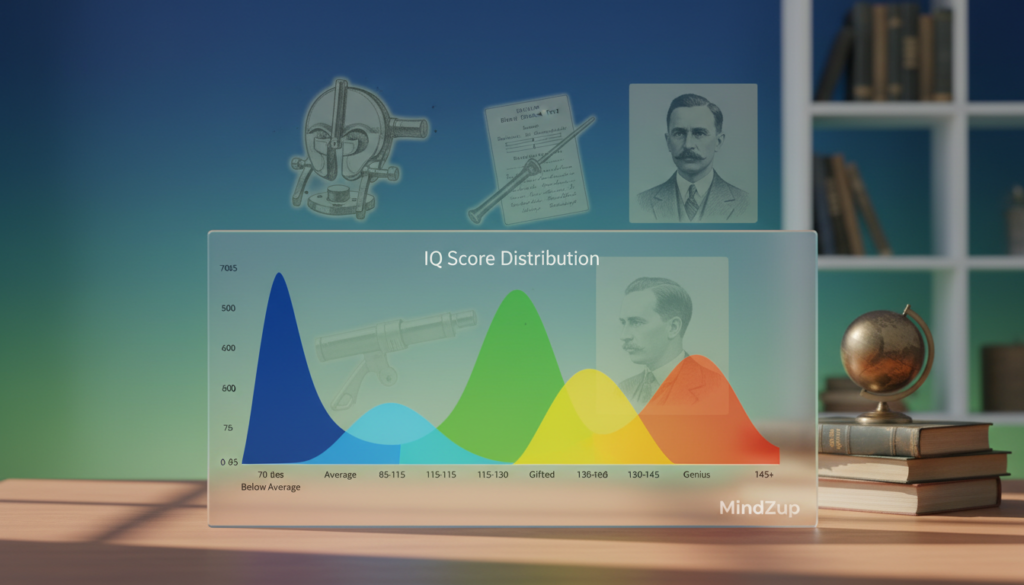
Interpreting your results is crucial for recognizing your unique cognitive profile. The bell curve is a helpful tool in understanding how your score fits within the general population. Most individuals score around the average of 100, while fewer achieve results at the extremes.
With a standard deviation of 15, approximately 68% of people will fall within the normal range of 85 to 115 points. This means that as you move away from the average of 100, the frequency of those scores decreases significantly.
This statistical framework allows you to see where you stand in relation to others. By examining the range on the chart, you can identify whether your performance is considered average, superior, or borderline.
- Your score chart is based on the bell curve, visually representing how scores are distributed.
- Understanding your score requires recognizing the implications of being above or below the average.
- This context provides valuable insights into your cognitive strengths and areas for improvement.
| Score Range | Classification | Percentage of Population |
|---|---|---|
| Below 70 | Below Average | 2.2% |
| 70 – 85 | Low Average | 13.6% |
| 85 – 115 | Average | 68% |
| 115 – 130 | High Average | 13.6% |
| Above 130 | Above Average | 2.2% |
Breaking Down the Standard IQ Score Range and Classifications
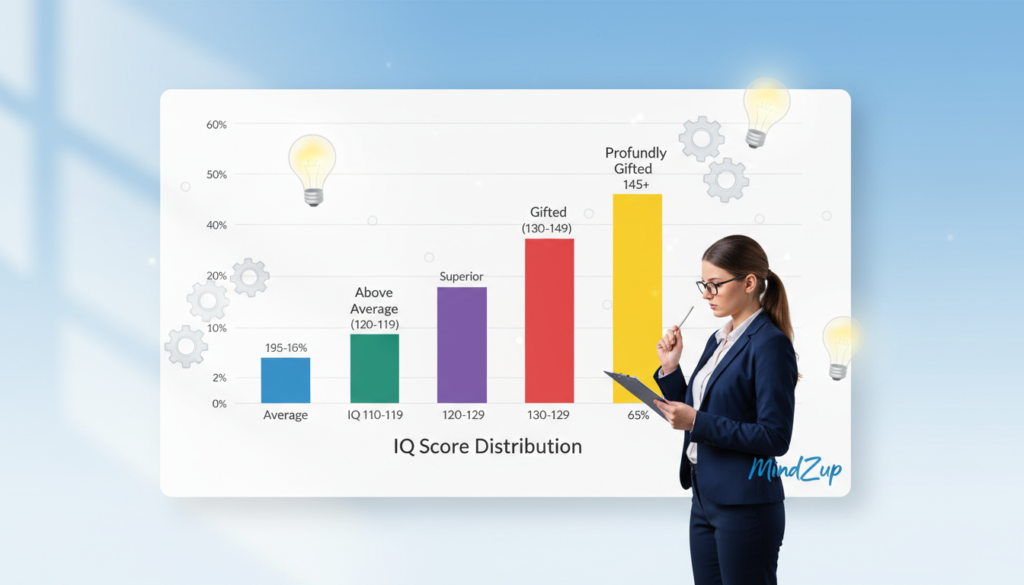
Understanding where you fit within the spectrum of intelligence can be enlightening. The concept of the bell curve is crucial in this discussion. It illustrates how scores are distributed among the population. With a standard deviation of 15, most people score between 85 and 115 points.
Classifications help you comprehend your cognitive abilities better. For instance, scores from 70 to 79 are considered borderline, while those scoring 130 and above are classified as very superior. A notable example is Marilyn vos Savant, who recorded an IQ of 228 at age ten, showcasing exceptional intelligence.
Additionally, a score range of 90 to 109 is identified as average intelligence. This range represents the most common performance level among people. Understanding your classification helps you see how your cognitive ability compares to the broader population within the established score range.
| Score Range | Classification | Percentage of Population |
|---|---|---|
| Below 70 | Below Average | 2.2% |
| 70 – 79 | Borderline | 6.7% |
| 80 – 89 | Low Average | 13.6% |
| 90 – 109 | Average | 68% |
| 130 and above | Very Superior | 2.2% |
Factors That Influence IQ Scores
Have you ever wondered what factors shape your cognitive abilities? Understanding these influences can help you gain insight into your performance. Various elements play a role in determining your cognitive scores.
One significant factor is the environment in which you learn and grow. Socioeconomic status and access to quality education are crucial. Studies show that these elements can greatly impact cognitive performance.
Environmental and Educational Influences
Access to quality education is essential. Research indicates that schooling directly enhances reasoning and problem-solving skills. This improvement can last a lifetime.
Genetic and Health-Related Impacts
Genetic factors provide a baseline for your cognitive potential. However, environmental influences often dictate how these abilities develop. Proper nutrition and healthcare during formative years are vital for brain development.
By enhancing your environment and pursuing new learning opportunities, you can improve your cognitive performance over time. Remember, intelligence is not solely determined by genetics; it can be nurtured.
- Recent research shows the Flynn Effect has increased average scores globally.
- Quality education is critical for developing essential skills.
- Genetics and environment together shape cognitive abilities.
- Nutrition and healthcare are crucial for brain development.
- Improving your surroundings can enhance your performance.
Age-Based Variations in IQ Scores
The relationship between age and intelligence is a fascinating topic. As you grow older, your cognitive abilities can change significantly. Understanding these variations helps you interpret your results more accurately.
Average IQ by Age Groups
For instance, individuals aged 16 to 17 years have an average IQ of 108. This reflects peak cognitive performance often seen in late adolescence. Because IQ is relative, every age group is standardized to maintain a mean score of 100.
Interpreting Age-Related IQ Trends
It’s essential to note that people of different ages are not compared directly. The tests account for developmental maturity, ensuring fair assessments. Trends indicate that average scores fluctuate throughout life, with unique patterns emerging in different age groups.
- Average scores for 16 to 17-year-olds are approximately 108.
- Each age group is standardized, keeping the mean score at 100.
- Direct comparisons between age groups are avoided to account for maturity.
- Average scores show fluctuations across the lifespan.
- Understanding these trends helps you compare your score with peers.
Utilizing Your IQ Score Chart for Personal Growth
Your assessment results can serve as a valuable guide for enhancing your skills. By understanding your unique cognitive profile, you can identify specific areas for improvement. This approach is essential for targeted learning and development.
Jim Kwik, author of Mindvalley’s Superbrain Quest, emphasizes that intelligence can be improved through training and the right coaching. He likens your brain to a muscle that can grow stronger with practice. Recognizing your strengths allows you to focus on the skills that will help you succeed.
Research into multiple types of intelligence suggests that your potential is not fixed. Instead, it can be expanded through continuous learning. Utilizing your results as a roadmap for personal growth enables you to sharpen your mind and achieve your best life.
- Identify specific cognitive abilities to strengthen through targeted learning.
- Focus on developing skills that will enhance your personal and professional success.
- Leverage your unique profile to create a personalized growth plan.
- Understand that your potential can grow with effort and dedication.
- Use your assessment as a tool to navigate your journey of improvement.

Applying the IQ Score Chart: Real-Life Implications
Navigating the implications of your cognitive assessment can be enlightening. Understanding your test results is essential, but it’s also crucial to recognize their limitations. These assessments measure specific cognitive abilities, but they do not encompass every aspect of intelligence.
While the average American IQ is 97.43, this number is just one indicator of potential success. Japan consistently ranks at the top of global studies, showcasing how education and environment influence average intelligence across different populations.
Many individuals find that their life success depends on more than just their scores. Emotional intelligence and resilience play significant roles in achieving personal and professional goals. By considering these factors, you can gain a more balanced perspective on your results.
- These assessments are only one measure of your abilities.
- Education and environment greatly impact cognitive performance.
- Success in life often requires skills beyond what tests measure.
- Understanding your results can help you navigate your career effectively.
- Embrace a holistic view of intelligence for personal growth.
Conclusion
Reflecting on your test results can provide deeper insights into your cognitive abilities. Your assessment is a valuable tool, but it should not define your life success. Studies today show that intelligence is influenced by both education and environment.
Most individuals fall within the average range, which is perfectly normal. This reflects the standard deviation of the population. As you compare your classification or results across age groups, remember that your potential is always evolving.
Continue to develop your skills and knowledge. These factors truly contribute to your long-term personal and professional success. Embrace your journey of learning, and let your results guide you toward growth.
FAQ
What does an IQ score represent?
An IQ score measures cognitive abilities and potential in relation to the average population. It reflects how well you can solve problems, reason, and understand complex ideas.
How are IQ tests standardized?
Standardized tests are designed to ensure consistency in scoring and interpretation. They are administered to a representative sample of the population, allowing for comparisons across different groups.
What are the different types of IQ tests?
There are various types of tests, including individual assessments and group tests. Each type evaluates different aspects of cognitive abilities, such as verbal skills and logical reasoning.
How do environmental factors affect IQ scores?
Environmental influences, such as education, socio-economic status, and access to resources, can significantly impact your cognitive development and, consequently, your test results.
Can IQ scores change over time?
Yes, IQ scores can fluctuate due to various factors, including changes in education, life experiences, and even health. Regular engagement in challenging cognitive activities can also contribute to score improvement.
What is the average IQ score?
The average score is typically set at 100, with most people scoring within a range of 85 to 115. This range represents the majority of the population, following a bell curve distribution.
How can I use my IQ score for personal development?
Understanding your score can help you identify your strengths and weaknesses. You can then focus on areas for improvement, whether in academics, career, or personal skills.
What are the limitations of IQ tests?
While IQ tests measure certain cognitive abilities, they do not encompass all aspects of intelligence, such as creativity, emotional intelligence, or practical skills. It’s essential to consider these factors when evaluating overall potential.