


Have you ever wondered how you can ride a bike without thinking about it? Or why you can type on your keyboard while chatting with a friend? These moments highlight a fascinating aspect of your brain’s capabilities. Implicit memory plays a crucial role in your everyday life, allowing you to perform tasks effortlessly.
This type of long-term memory operates beneath your conscious awareness. It helps you navigate familiar routes or complete routine actions, such as brushing your teeth, without needing to think about each step. Research indicates that even individuals with frontal lobe damage or Alzheimer’s disease retain this kind of memory, as it is stored in parts of the brain that remain unaffected.
Understanding this form of memory is essential. It not only shapes your daily experiences but also reveals how your brain processes and stores information over time. This guide will explore the different types of implicit memory, its mechanisms, and its practical applications in your life.
Key Takeaways
- Implicit memory operates without conscious thought, influencing daily tasks.
- It allows for automatic actions like typing or riding a bike.
- This memory type is retained even in certain brain injuries.
- Understanding it can enhance your grasp of learning and behavior.
- The guide will cover testing methods and mental health connections.
What is Implicit Memory?
Ever noticed how you can perform tasks like riding a bike without actively thinking about it? This phenomenon highlights a fascinating type of long-term memory. It allows you to store and recall information effortlessly, often without even realizing it.
For instance, when you hop on a bike after years of not riding, your body instinctively knows what to do. Initially, learning to ride requires conscious effort. However, once you’ve mastered it, your brain and body retain that knowledge. This form of memory is often called non-declarative memory because you cannot easily verbalize the information it contains.
Implicit memory operates automatically, storing information that you retrieve without conscious effort. Unlike explicit memory, which involves intentional memorization of facts and figures, this type works in the background of your mind. It preserves motor skills and other learned tasks, demonstrating its durability even after long periods of disuse.
This memory type forms through repetition and practice. Over time, it encodes tasks until they become second nature. From procedural skills, like typing, to conditioned responses, implicit memory is essential for daily functioning.
Interestingly, implicit memory does not rely on the hippocampus as explicit memory does. This is why it often remains intact in certain neurological conditions. The term “implicit” reflects how these memories influence your behavior indirectly, without entering conscious awareness.
Understanding this foundational concept sets the stage for appreciating its profound impact on your daily life and learning processes. The exploration of implicit memory will continue in the following sections, diving deeper into its types and real-world applications.
How Does Implicit Memory Influence Your Daily Life?
Ever reflect on how your brain manages to execute tasks without your active involvement? This fascinating aspect of memory plays a significant role in your daily activities. You might not realize it, but implicit memory quietly orchestrates countless actions throughout your day.
From morning routines like showering and getting dressed to commuting to work on autopilot, implicit memory helps you navigate these tasks seamlessly. For example, when you drive a car, your brain coordinates the necessary movements without you consciously thinking about each one.
Procedural memory is a vital part of this process. It governs motor tasks such as walking, typing, and riding a bicycle. You perform these actions automatically, demonstrating how your brain stores and retrieves information efficiently.
Priming also plays a crucial role in shaping your behavior. This occurs when past experiences influence your reactions. For instance, after watching a horror movie, you might flinch when someone unexpectedly startles you. Such responses highlight how implicit memory affects your everyday life.
Additionally, implicit memory allows you to navigate familiar environments—your home, neighborhood, or office—without needing GPS or explicit directions. This capability showcases how your brain retains and utilizes information effortlessly.
Interactions between implicit and explicit memory happen daily. You might consciously recall a fact while your implicit memory manages the physical act of writing it down. Similarly, singing along to a song you haven’t heard in years illustrates how implicit memory retrieves words and melodies through auditory cues.
These influences often go unnoticed, yet they form the backbone of your ability to function efficiently in daily life. By freeing up your brain to focus on more complex tasks, implicit memory enhances cognitive efficiency and saves time.
Recognizing these influences can help you appreciate the power of implicit memory in your experiences and behaviors. In the next section, we will explore the distinct types of implicit memory, each with unique mechanisms that contribute to your daily life.
| Task | Type of Implicit Memory | Example |
|---|---|---|
| Walking | Procedural Memory | Moving without thinking |
| Driving | Procedural Memory | Executing maneuvers automatically |
| Flinching | Priming | Reacting to a surprise after a horror movie |
| Navigating | Procedural Memory | Finding your way without GPS |
| Singing | Priming | Recalling lyrics from memory |
Types of Implicit Memory
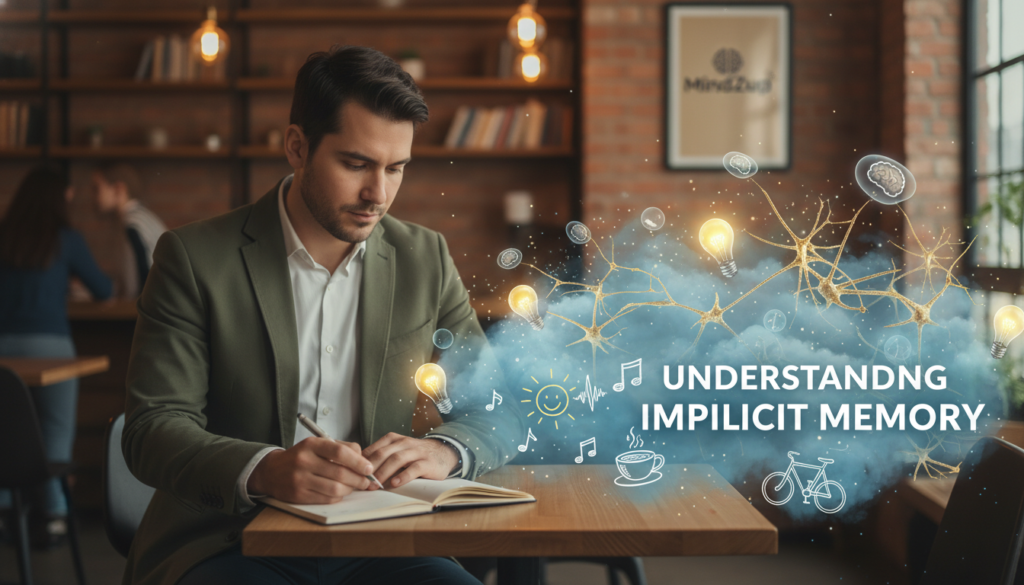
Consider how often you complete tasks without even thinking about them. Implicit memory consists of various types that play crucial roles in your daily life. Understanding these types can help you recognize how they influence your behavior and learning.
Procedural Memory
Procedural memory is responsible for your motor skills and habits. This system allows you to perform tasks like typing on a keyboard or riding a bicycle automatically after sufficient practice. Once you learn these skills, they become second nature, freeing your mind for other activities.
Priming
Priming occurs when previous experiences subtly influence your current behavior. For instance, after watching a horror movie, you might scream when startled. This response demonstrates how your brain links past stimuli to present reactions, enhancing your ability to respond quickly.
Another example of priming can be seen when you hear the first few notes of a song. This exposure can trigger an instant recall of the lyrics, showcasing the powerful connection between stimuli and memory.
Classical Conditioning
Classical conditioning involves associating unrelated stimuli with specific responses. A famous example is Pavlov’s dogs, which learned to salivate at the sound of a bell. In modern life, you might find yourself checking your phone when you hear a notification sound, even if you’re not expecting a message.
These types of implicit memory work together seamlessly. Procedural memory handles your physical skills, priming shapes your perceptions, and classical conditioning drives your emotional responses. All three operate without conscious awareness, helping you navigate daily life efficiently.
Recognizing these types enhances your understanding of how implicit memory influences your actions and decisions. By appreciating these mechanisms, you can harness their power for better learning and behavior.
Implicit Memory vs. Explicit Memory
Have you ever considered how your mind effortlessly recalls facts and experiences? Understanding the distinction between explicit memory and implicit memory is crucial for grasping how we learn and remember. Explicit memory involves conscious recollection of information, while implicit memory operates in the background, influencing our actions without our awareness.
What is Explicit Memory?
Explicit memory refers to the conscious, declarative form of long-term memory. It includes memories of facts, events, and personal experiences that you can intentionally recall. This type of memory is further divided into two subtypes:
- Semantic Memory: This involves general knowledge about the world, such as remembering state capitals or historical facts.
- Episodic Memory: This type pertains to personal events, like recalling your wedding day or a family vacation.
Key Differences and Examples Between Implicit and Explicit Memory
Both types of memory work together in daily life. For instance, during a job interview, your implicit memory helps you maintain eye contact and offer a firm handshake. Meanwhile, your explicit memory retrieves relevant personal experiences to answer questions.
Here are some key differences:
| Aspect | Explicit Memory | Implicit Memory |
|---|---|---|
| Consciousness | Requires deliberate retrieval effort | Operates automatically |
| Brain Structures | Involves the hippocampus | Involves the basal ganglia and cerebellum |
| Types of Information | Facts and personal experiences | Skills and conditioned responses |
| Example | Riding a bike |
The case of Henry Gustav Molaison (HM) is particularly illuminating. After surgery that damaged his hippocampus, he could not form new explicit memories. However, he still improved on tasks like mirror drawing, showcasing intact implicit memory.
Understanding the distinctions between implicit and explicit memory is essential. Both systems complement each other, shaping your learning, behavior, and overall experiences. You might know grammar rules explicitly, but you use them implicitly when speaking your native language.
In summary, the divide between implicit and explicit memory is not absolute. Instead, these complementary systems work together to enhance your cognitive abilities and daily functioning.

The Brain and Implicit Memory
Imagine how your brain effortlessly manages various tasks, often without you even realizing it. Understanding the regions of the brain involved in implicit memory reveals how you perform actions automatically. Two critical areas are the basal ganglia and the cerebellum.
Role of the Basal Ganglia and Cerebellum
The basal ganglia play a vital role in habit formation, movement, learning, and emotional processing. This area helps you develop skills that become second nature over time. For example, riding a bike or playing a musical instrument relies heavily on this part of the brain.
Meanwhile, the cerebellum is essential for fine motor control and coordination. It stores the precise movement patterns needed for activities like typing or playing sports. Together, these areas work seamlessly to encode and retrieve implicit memories without requiring conscious thought.
Hippocampus and Other Brain Areas Involved in Memory
In contrast, the hippocampus is crucial for explicit memory formation and retrieval. It helps you recall facts and experiences intentionally. However, implicit memory is stored in the basal ganglia, cerebellum, and neocortex, allowing it to remain intact even when the hippocampus is damaged.
Research from 2020 indicates that individuals with frontal lobe damage or Alzheimer’s disease can still retain their implicit memory. This resilience occurs because these conditions primarily affect the hippocampus and frontal areas, sparing the basal ganglia and cerebellum.
The amygdala also plays a role in both implicit and explicit emotional memory processes. It connects emotional responses to memories, enhancing your ability to react to situations based on past experiences.
Understanding the differences between these brain areas highlights how implicit and explicit memory can function independently. The temporal lobe houses the hippocampus, while the frontal lobe supports working memory. Recognizing these structures provides insight into how implicit memory operates beneath conscious awareness.
| Brain Area | Function | Memory Type |
|---|---|---|
| Basal Ganglia | Habit formation, movement, learning, emotional processing | Implicit Memory |
| Cerebellum | Fine motor control, coordination | Implicit Memory |
| Hippocampus | Explicit memory formation and retrieval | Explicit Memory |
| Neocortex | Long-term implicit memory storage | Implicit Memory |
| Amygdala | Emotional memory processing | Both |
How Implicit Memory Works Without Conscious Thought
Consider how your mind often completes everyday actions without any conscious effort. This automatic nature of implicit memory allows you to retrieve information and guide your behavior effortlessly. You might not even realize it, but your brain manages these processes in the background.
Implicit memory operates through two main pathways. First, it responds to familiar stimuli in your environment. Second, it helps you execute well-learned tasks on autopilot. For instance, when you hear a song, your brain can automatically supply the lyrics, even if you only hear the instrumental version.
Once a task like typing or driving becomes encoded in your implicit memory, your mind no longer needs to actively think about each step. This frees up cognitive resources for other activities, allowing you to multitask more effectively.
The concept of dual processing illustrates how your implicit and explicit memory systems work simultaneously. While your implicit memory handles routine behaviors, your explicit memory tackles novel problems. This unconscious operation makes implicit memory highly efficient, enabling you to navigate complex environments without mental fatigue.
Implicit memory relies on strengthened neural connections in the basal ganglia and cerebellum. These areas of the brain fire automatically when triggered by relevant stimuli. Over time, through repetition and practice, tasks shift from conscious, effortful processing to unconscious, effortless execution.
Interestingly, you often cannot verbalize how you perform these tasks. For example, explaining how to balance on a bike can be challenging, even though you can ride one perfectly. This unconscious nature of implicit memory is not a limitation but a feature that enables you to function smoothly in daily life.
Examples of Implicit Memory in Action
Picture yourself cycling down the street, your body instinctively knowing how to balance and steer without any mental effort. This classic scenario illustrates how implicit memory operates in our daily lives. You can hop on a bike and ride it, even after years of not doing so, thanks to the power of procedural memory.
Here are some rich examples of implicit memory in action:
- Riding a Bike: Once you learn to ride, your body remembers the physics involved, like countersteering. You turn the handlebars slightly left to go right, all without thinking about it.
- Touch-Typing: Your fingers know the keyboard layout implicitly. Even if you struggle to name the letters on the top row, you can type effortlessly.
- Daily Routines: Activities like brushing your teeth, tying your shoes, or navigating your neighborhood are all tasks you perform on autopilot after initial learning.
- Driving a Car: When driving, you manage steering, braking, and scanning for hazards simultaneously without conscious deliberation.
- Priming Effects: Hearing the first few notes of a song can trigger an automatic recall of the lyrics. Similarly, a scary movie might prime you to react when startled later.
- Word Completion: You might find it easy to fill in missing letters of a word based on prior exposure to related words, demonstrating the influence of priming.
Recognizing these examples in your own experiences helps you appreciate the pervasive influence of implicit memory on your daily behavior. These skills evolve from effortful tasks into automatic actions over time through repetition, enhancing your efficiency in everyday life.
Testing and Assessing Implicit Memory
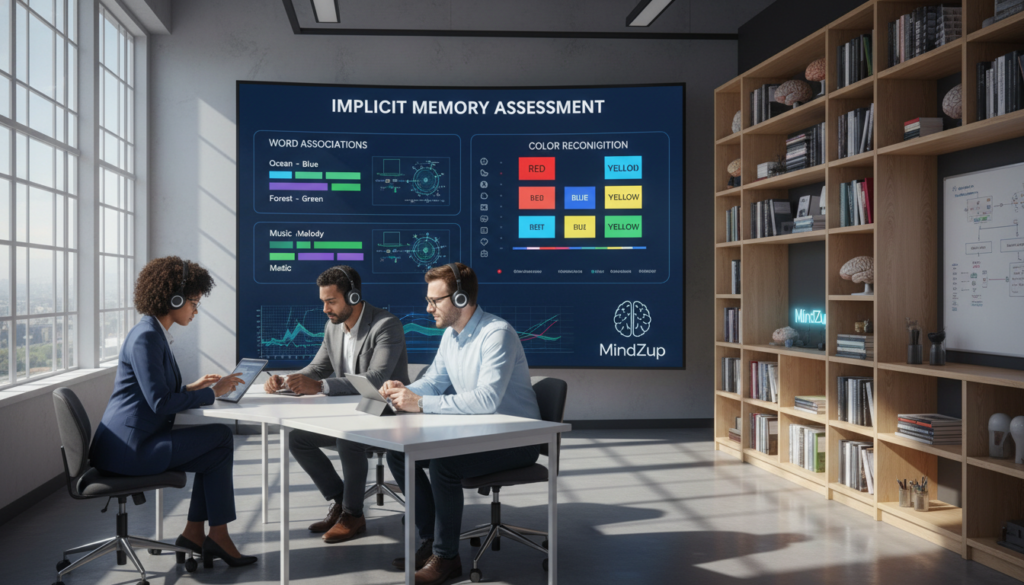
Consider how your mind processes tasks automatically, often without your awareness. Researchers have developed various methods to test this fascinating aspect of memory. These assessments measure unconscious memory without requiring you to recall information consciously.
Verbal and Nonverbal Tests
Verbal tests are designed to assess different types of implicit memory. For example, word-stem completion tasks require you to fill in missing letters based on prior exposure to words. Similarly, category production tests tap into conceptual priming, allowing you to generate words related to a specific category.
Nonverbal tests also play a crucial role in assessing implicit memory. Picture-fragment identification tasks help you recognize degraded images faster after prior exposure. Another example is the mirror drawing task, which evaluates procedural memory by requiring you to trace figures while looking in a mirror.
Real-Life Examples of Implicit Memory Tests
A popular example of testing implicit memory involves the TikTok trend known as “blind karaoke.” In this activity, singers perform karaoke without lyrics, relying solely on their implicit memory to recall the words. This showcases how people can demonstrate learning without being able to verbally report what they learned.
Additionally, research has shown that priming can be measured through reaction time tasks. When you respond faster to previously seen words or images, it indicates that implicit memory is at work. Such tests reveal the differences between implicit and explicit memory, highlighting how your brain can activate related information automatically.
Interestingly, studies using these tests have shown that implicit memory remains intact in amnesia patients. This finding provides key insights into the separate brain systems for different memory types. General knowledge tests can also assess semantic priming, revealing how your brain activates related information without conscious effort.
In conclusion, testing implicit memory helps scientists understand how your mind stores and retrieves information outside of conscious awareness. By exploring these methods, you gain insight into the remarkable capabilities of your brain.
| Test Type | Description | Example |
|---|---|---|
| Verbal | Assesses conceptual and procedural memory | Word-stem completion |
| Nonverbal | Evaluates recognition and procedural memory | Picture-fragment identification |
| Real-Life Example | Demonstrates reliance on implicit memory | Blind karaoke |
| Priming | Measures reaction time for previously seen stimuli | Faster responses to words |
| Research Findings | Shows memory intact in amnesia patients | Implicit memory tests |
Implicit Memory and Mental Health
Think about how your memory plays a crucial role in your mental health. Memory function can serve as a barometer for cognitive and emotional well-being. Persistent lapses or forgetfulness may indicate underlying conditions such as depression or anxiety.
Interestingly, conditions like these can affect your memory processes. They often impair explicit memory while leaving implicit memory relatively intact. This means you might struggle to recall specific events, yet still remember how to perform daily tasks.
In cases of Alzheimer’s disease, implicit memory showcases remarkable resilience. Patients often retain procedural skills like walking, talking, and reading long after explicit memories of people and events fade. Research indicates that implicit memory is stored in brain areas less affected by early-stage Alzheimer’s, such as the basal ganglia and cerebellum.
Therapy for memory concerns usually involves assessing both implicit and explicit memory. This comprehensive approach helps mental health professionals understand your cognitive health better. Traumatic experiences can also become encoded in implicit memory, leading to automatic fear responses that may require therapeutic intervention.
Diagnosing and treating memory-related conditions often involves a collaborative effort. Mental health professionals, neurologists, and geriatric specialists work together to ensure comprehensive care. Understanding the role of implicit memory in mental health can help you recognize early warning signs and seek appropriate care.
Moreover, implicit memory can be harnessed in therapeutic settings. For example, procedural learning can help patients regain lost skills. In conclusion, memory and mental health are deeply intertwined. Preserving implicit memory can maintain quality of life even when other cognitive functions decline.
Tips for Enhancing and Using Your Implicit Memory
Reflect on how you can complete familiar tasks effortlessly, almost on autopilot. Enhancing your implicit memory can significantly improve your daily experiences and skills. Here are some actionable tips to help you strengthen this vital aspect of your memory.
1. Embrace Repetition: Consistent practice is key. Repeating tasks helps solidify neural pathways in the basal ganglia and cerebellum. This repetition allows you to perform actions automatically over time.
2. Blend Learning Styles: Combine intentional, explicit learning with routine, implicit application. For instance, consciously studying a musical scale and then practicing it until it becomes automatic can enhance your skills.
3. Engage Your Senses: When trying to remember something, use multiple senses. Visualizing, touching, or associating a scent can create richer memory traces that both implicit and explicit memory can access.
4. Prioritize Sleep: Sleep is essential for memory consolidation. Your brain processes and stores implicit memories during downtime, making rest crucial for enhancing your memory.
5. Break Down Skills: Divide complex skills into smaller, repeatable tasks. This method allows your mind to gradually encode these tasks as implicit memories through consistent practice.
6. Create Routines: Establishing habits can leverage implicit memory. Routines make desired behaviors automatic, reducing the mental effort required to maintain them.
7. Trust Your Memory: Allow yourself to perform learned skills without overthinking. Conscious interference can disrupt automatic processes, so trust your implicit memory.
8. Use Spaced Repetition: Practicing skills at intervals over time strengthens long-term implicit memory retention. This technique enhances your ability to recall information effortlessly.
9. Maintain Brain Health: Reducing stress and supporting overall brain health through exercise and nutrition is vital. These factors contribute to the optimal function of both implicit and explicit memory systems.
In conclusion, enhancing your implicit memory involves working with your brain’s natural learning processes. By implementing these strategies, you can build lasting skills and habits that improve your daily life.
Conclusion
Consider how you can engage in activities like driving or typing without conscious thought. This type of long-term memory, known as implicit memory, plays a crucial role in shaping your daily experiences. It operates alongside explicit memory, allowing you to navigate tasks effortlessly.
Both systems are essential for guiding your decisions and behaviors. Implicit memory helps with motor skills and automatic responses, while explicit memory aids in recalling facts and experiences. Neither is more important; together, they enable you to function effectively in a complex world.
Understanding the implications of implicit memory can enhance your learning and skill acquisition. By applying techniques such as repetition and multisensory learning, you can strengthen this vital aspect of your memory. Embrace the efficiency of your brain, and recognize how it supports you in everyday tasks.
As research continues, the insights gained from studying implicit memory may unlock further understanding of human cognition and behavior. Your journey into the world of memory is just beginning.
FAQ
How can you improve your implicit memory?
Engaging in activities that require practice, such as playing a musical instrument or learning a new sport, can enhance your skills and strengthen your implicit memory. Consistent repetition and exposure to various stimuli also play a crucial role.
What are some real-life examples of implicit memory?
Riding a bike or typing on a keyboard are classic examples. You may not consciously recall how to perform these tasks, but your body knows how to execute them seamlessly.
How does implicit memory differ from explicit memory?
Implicit memory involves skills and tasks you perform without conscious thought, while explicit memory requires active recall of facts and events. For instance, recalling your birthday is explicit, but knowing how to drive a car is implicit.
What role does the brain play in implicit memory?
Key areas such as the basal ganglia and cerebellum are crucial for processing and storing skills and habits. The hippocampus, while more associated with explicit memory, also contributes to the overall memory process.
Can implicit memory affect your behavior?
Yes, implicit memory can significantly influence your behavior. For example, past experiences may shape your reactions to certain stimuli, often without your conscious awareness.
What types of tasks rely on implicit memory?
Tasks such as playing sports, dancing, or even simple daily routines like brushing your teeth rely heavily on this type of memory, as they become automatic through practice.
How do you assess implicit memory?
Implicit memory can be assessed through various tests, including tasks that measure reaction times or the ability to complete patterns without direct instruction, such as word completion tasks.
What impact does implicit memory have on learning?
It plays a vital role in learning new skills and habits. As you practice, your brain forms connections that allow you to perform tasks more efficiently without conscious effort.